The Saiga Antelope


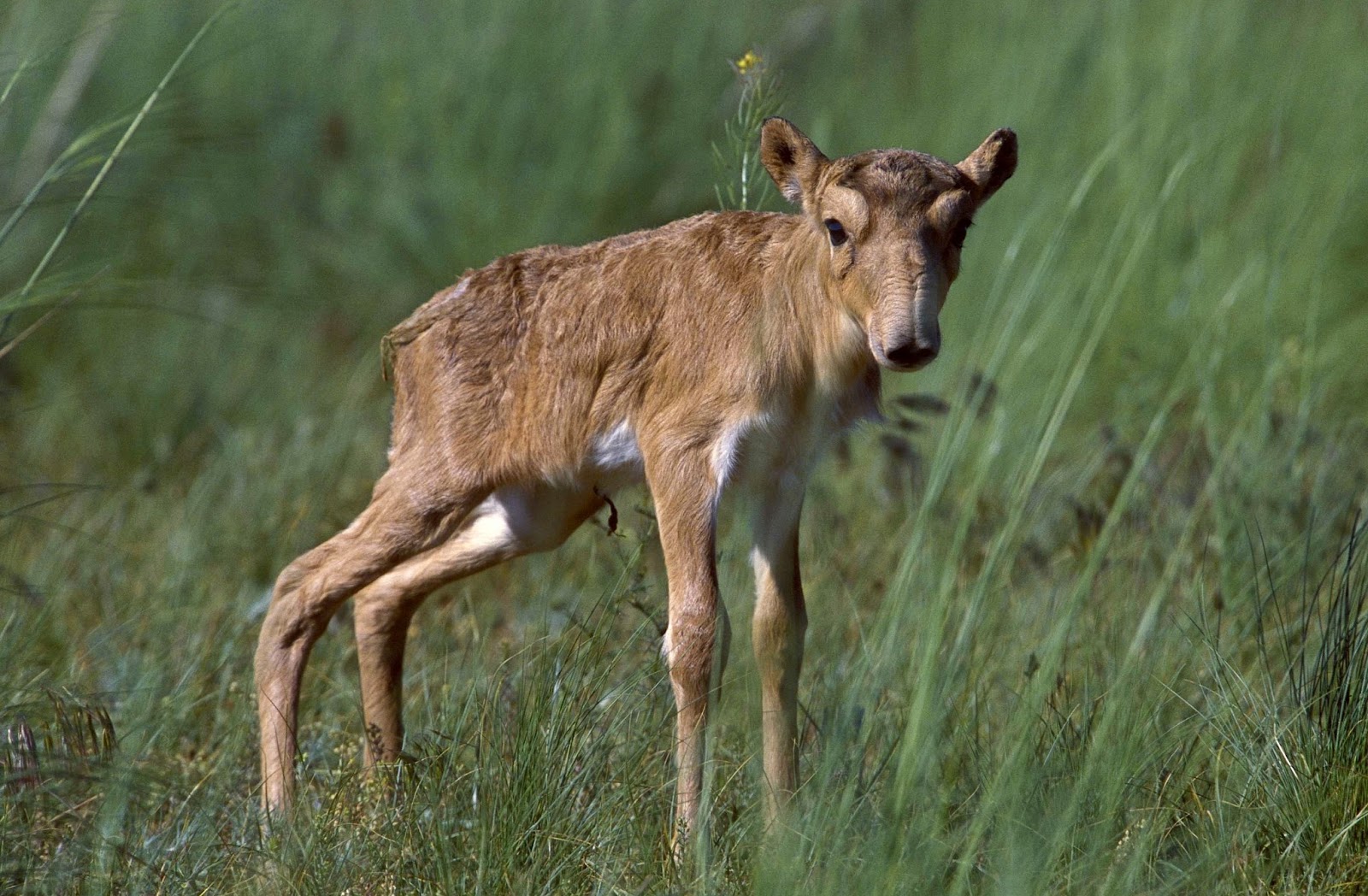
            Saiga antelope have an extremely distinctive appearance with an enlarged nose that hangs down over the mouth. Despite their common name these ungulates are thought to be intermediates between antelope and sheep. The coat is sparse and cinnamon-buff in the summer but becomes white and around 70 percent thicker in winter. The underbelly is light in colour throughout the year, and there is a small mane on the underside of the neck. Mature males have almost vertical horns; these are semi translucent and are ringed in the bottom sections.

            The saiga typically stands 0.6–0.8 m (1 ft 10 in–2 ft 7 in) at the shoulder and weighs between 36 and 63 kg (79 and 140 lb). The horned males are larger than the polled females. Their lifespans range from 6 to 10 years. The saiga is recognizable by an extremely unusual, over-sized, flexible nose structure, the proboscis.


Did You Know

            The saiga antelope is active mostly during the day, although it may rest at midday.  A nomadic species, saiga have no fixed home ranges and usually walk several dozen kilometers in a given day.  The saiga is an extremely good runner, and is able to reach speeds up to 80 kmph / 48 mph.  Populations undertake seasonal migrations, moving north in the spring to the summer grazing grounds, and returning southward in the fall. Covering 80-120 km / 48-72 miles per day, saiga march with their heads low to the ground, with their specialized noses filtering out the stirred up dust from the air.


Scientific Classification

Kingdom
Animalia
Phylum
Chordata
Class
Mammalia
Order
Cetartiodactyla
Family
Bovidae
Genus
Saiga
Species
tatarica

Other Names

English
Saiga Antelope
French
Saïga
Spanish
Antílope Saiga

Status

            Classified as Critically Endangered (CR) on the IUCN Red List 2007, and listed on Appendix II of CITES. It is also listed on Appendix II of the Convention on the Conservation of Migratory Species (CMS or Bonn Convention). Subspecies: Mongolian saiga (Saiga tatarica mongolica) classified as Endangered (EN) and the Russian saiga (S. t. tatarica) is Critically Endangered (CR) on the IUCN Red List 2007.

Population

            Historically, this was a common species in Eurasian steppes and semi-deserts. From information provided in recent references it appears that between 1991 and 1994, the global population of S. tatarica was relatively stable at just under one million animals, the majority of which were in Kazakhstan (approximately 810,00–825,000). However, the population in Kazakhstan had fallen to around 570,000 animals by 1998.


            In European Russia (Kalmykia), the Saiga population steeply declined after land reclamation of the Volga basin started, but the species remained numerous within the distribution area. In the 1970s the population recovered to ca.700,000–800,000 as a result of hunting regulation. However, since then the population has drastically declined. In 1980 there were an estimated 380,000 individuals, in 1996 there were 196,000, and by 2000 just 26,000. 2001 for annual survey results for 1980–2000). At present there are no more than 18,000 animals in Kalmykia. Sex ratio is severely skewed; the proportion of males varies from 1 to 10% in different years.

Habitat

            Saigas typically inhabit open dry steppe and semi desert grasslands of Central Asia and Pre-Caspian region. They prefer open areas free from dense vegetation where they can avoid predators such as wolves and humans.


Range

            Saiga tatarica inhabited the steppes and semi-desert regions of south-eastern Europe and Central Asia from the Precaspian steppes to Mongolia and western China. Currently, there is one population in Russia (Kalmykia) and three in Kazakhstan, although in winter some animals reach Uzbekistan and even northern Turkmenistan. A distinctive subspecies occurs in western Mongolia. Saiga became extinct in China by the 1960s, and in Ukraine in the 18th century.


Biology

            Saiga is nomadic animals and undertakes seasonal migrations from summer pastures in steppe grassland to winter pastures in desert areas. Large groups of saiga migrate southwards to the winter grounds, covering up to 72 miles in a day. The rut begins in late November and males gather groups of around 30 females in ‘harems’, which they defend aggressively. During the rut, males’ noses swell up and the hair tufts below the eyes are covered in a sticky secretion. Males do not feed much during the rutting season, when they take part in violent fights that often end in death. The male mortality rate can reach 90 percent during this time, due to exhaustion. Surviving males begin to migrate north at the end of April.


            Females give birth at this time, usually to two young, which are initially concealed in vegetation; all the females within the herd will give birth within a week of each other. Once the calves are a few days old, the whole herd breaks into smaller herds which head northwards to the summer feeding grounds. Once there, smaller groups break off, reforming again for the journey south the following autumn.


            Saiga grazes on a number of different grasses, herbs and shrubs. The unusual swollen nose is thought to filter out airborne dust during the dry summer migrations and to enable cold winter air to be warmed before it reaches the lungs.

Threats

            All the saiga populations have suffered from habitat degradation, poaching and disturbance. Droughts or severe winters, diseases and predation pressure from wolves can also act as threats of saiga populations, although these are unlikely to be major causes of the decline.

            Saiga within the former Soviet Union was the subject of concerted conservation programmes, so much so that the population reached almost one million individuals. Management of the species has now broken down however and illegal poaching is rife. Saiga horns are highly valued in traditional Chinese medicine as cures for illnesses such as strokes. Only the males of the species bear horns and poaching thus produces a population where there are far more females than males. The average life span of saiga is only around three to four years and if females do not mate every year the species can rapidly decline.


            Another main cause of the saiga's decline is the overgrazing of its pastures, general habitat degradation and construction of roads and canals. Before 1991 numbers of livestock, particularly sheep increased enormously. As a result the quality of the pastures for saiga has deteriorated

Conservation Measures

            The saiga antelope’s listing on Appendix II of the Convention on International Trade in Endangered Species (CITES) means that any trade in this species should be carefully monitored. Hunting is banned throughout the saiga’s range. Further research into saiga reproductive behaviour is needed to assess the impact of hunting and this may be used to produce an effective conservation action plan.


            In order to conserve this species, protected areas for lambing and rutting should be established where saiga populations are present. Given that poaching for domestic consumption is now a major threat, strengthening of anti-poaching law enforcement is crucial. It is considered to be more important to fund national conservation action than to improve the international trade control

References

http://en.wikipedia.org/wiki/Saiga_antelope
http://www.fws.gov/international/animals/saiga-antelope.html
http://www.edgeofexistence.org/mammals/species_info.php?id=62
http://www.ultimateungulate.com/artiodactyla/saiga_tatarica.html
http://kids.nationalgeographic.co.in/kids/stories/animalsnature/saiga/
http://wwf.panda.org/what_we_do/endangered_species/saiga_antelope/

The Himalayan Monal


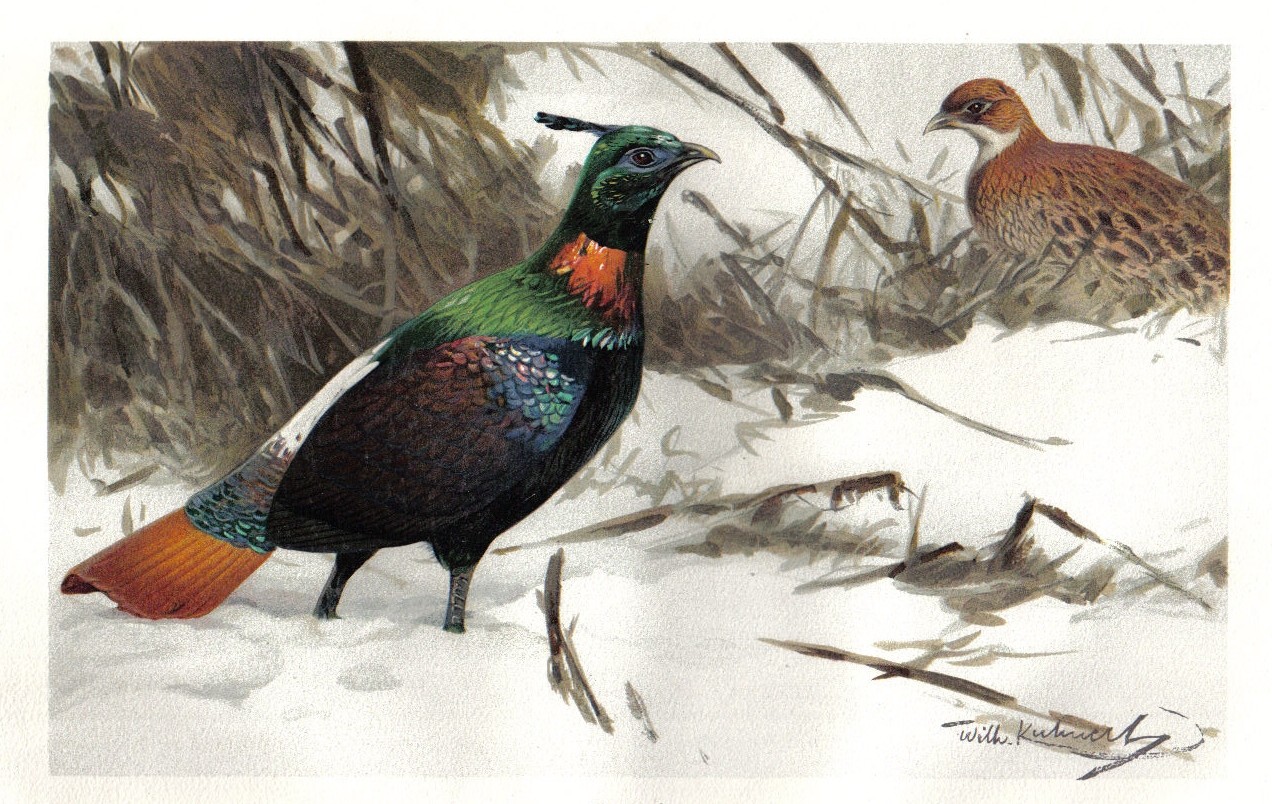
            A stunningly colourful member of the pheasant family, the Himalayan monal is the national bird of Nepal. The iridescent rainbow-like plumage of the male is surpassed only by the slightly larger Chinese monal (Lophophorus lhuysii). The male Himalayan monal possesses a wiry, metallic green head-crest that is absent in other monal species, as well as a chestnut brown tail, light brown wings and a white rump that is visible in flight. The head is bright green, the eyes ringed with blue and the neck reddish brown. At the nape of the neck is a yellow patch which forms the top edge of the bluish black wings and the purplish black back. The breast is dark brown and the tail feathers are light brown.


            Females do not share the same splendour as males, with overall dark brown feathers, except for a white throat and rump patch, and the bright blue circle around the eyes. The female also has a crest, but whereas the male’s is green and has spoon-shaped feathers, the female’s is shorter, and brown with ordinary feathers.


Did You Know
            The Himalayan Monal undertakes an annual migration, but to a lesser degree. During winter this species can be located at the lower end of its altitude distribution. The Western Tragopan and the Himalayan Monal occupy the same blocks of forest and can be observed together throughout the year. It is unlikely that there is a high degree of competition as their feeding and nesting biology differs slightly, permitting the two species to co-inhabit.


Scientific Classification

Kingdom
Animalia
Phylum
Chordata
Class
Aves
Order
Galliformes
Family
Phasianidae
Genus
Lophophorus
Species
L. impejanus

Other Names
English
Himalayan Monal
Local Name
Impeyan Pheasant

Status
                     Classified as Least Concern (LC) on the IUCN Red List 2006 and listed on Appendix I of CITES.

Population
           The population size has not been quantified, but it is not believed to approach the thresholds for Vulnerable under the population size criterion (<10,000 mature individuals with a continuing decline estimated to be >10% in ten years or three generations, or with a specified population structure). For these reasons the species is evaluated as Least Concern.


Habitat
            During the summer months, the Himalayan monal ventures above the tree-line to wander on the grassy slopes, but during winter it is found in coniferous and mixed forests with a high proportion of rhododendrons and bamboo, where it shelters from the weather. It is a high-altitude species, remaining between 2,100 and 4,500 metres above sea level


Range
            Found in the Himalayas from eastern Afghanistan to Bhutan, northeast India and southern Tibet; the Himalayan monal has also been reported from Burma.
           

Biology
            A highly communicative bird, the Himalayan monal uses several different call types to express meaning to its mate, other birds in its foraging group, or intruding birds. Males also use body displays to attract females; bobbing the head-crest and fanning their tail feathers. The breeding season begins in April when the monals are at higher altitudes. The male switches from calling only in the early morning to calling throughout the day. 


              Once a female notices his display they mate and shortly afterwards she scrapes a nest in the ground and lays between three and five eggs. The female must incubate the eggs alone, but the male will stand guard throughout the 27-day incubation period and until fledging to protect the eggs and chicks from predators. After six months the young are completely independent and must search for food and mates alone.


            Like many of the pheasants, quails and partridges in the Phasianidae family, the Himalayan monal has very strong legs and a long, curved beak which together enable it to dig into the hard soil of the mountains to uncover seeds, tubers, shoots, berries, and insects. This method of foraging leaves conspicuous areas of turned over soil up to 25 cm deep on hillsides


Threats
            The specific requirements of the Himalayan monal make it important to conserve its habitat, but currently this beautiful bird is not seriously threatened. In many parts of its range tree harvesting takes place and additionally this pheasant is hunted for food. It is also hunted for the colourful plumes of its headdress by the inhabitants of Kulu Valley, but this practice appears to have declined significantly in the last ten years. For now the Himalayan monal is not facing any serious threat.


Conservation Measures
            The Himalayan monal’s status as the national bird of Nepal helps to raise awareness of this stunning bird and its needs, and it is hoped that this may keep the species safe in the future. It is currently common and has been recorded in many protected areas in its range, as well as many areas that are not suffering degradation. It is listed on Appendix I of the Convention on International Trade in Endangered Species of Fauna and Flora which prevents unlicensed export of the species or its body parts. This listing prevents the possibility that such an extraordinary bird might find popularity as a pet


References
http://en.wikipedia.org/wiki/Himalayan_Monal
http://www.birdlife.org/datazone/speciesfactsheet.php?id=243
http://www.arkive.org/himalayan-monal/lophophorus-impejanus/
http://www.gbwf.org/pheasants/monal.html
http://whozoo.org/Intro2003/AprilStJ/AS_himalayanMonalfinal.html

The Bornean Orangutan


            The Bornean Orangutan (Pongo pygmaeus) is one of only two species of Orangutan, which together are the only species of great apes to be found in Asia, and Orangutans are the largest tree-dwelling mammals in the world. Orangutans have a distinctive body shape, with very long arms that may reach up to two metres in length. They have a coarse, shaggy, reddish coat and grasping hands and feet. The skin of the face is bare and black, but can be pinkish around the eyes and muzzle in younger individuals.


            Orangutans are highly sexually dimorphic, with adult males being distinguished from females by their larger size. The adult male Bornean Orangutan occurs in two forms, flanged or unflanged. Flanged males are larger than unflanged males, and also differ in possessing fleshy, protruding ‘flanges’, or cheek pads, on either side of the face. The transition from the unflanged to the flanged form can happen anytime; this depends mostly on complex social cues that are not yet fully understood.


Did You Know
            
            Bornean Orangutans build nests from bent branches high up in the trees where they sleep at night. On average, female Orangutans only give birth every eight years, making them the slowest breeding of all mammal species.


Scientific Classification

Kingdom
Animalia
Phylum
Chordata
Class
Mammalia
Order
Primates
Family
Hominidae
Genus
Pongo

Other Names

English
Bornean Orang-utan
Spanish
Orang-után
French
Orang-outan De Bornéo

Status
          
            The Bornean Orangutan is classified as Endangered (EN) on the IUCN Red List, and listed on Appendix I of CITES.


Population

            The Bornean Orangutan is the most endangered subspecies. Core populations are found in four protected areas in western Borneo: Lanjak Entimau, Batang Ai, Danau Sentarum and Betung Kerihun. Its stronghold, Danau Sentarum, has been seriously affected by logging and hunting, and a mere 1,500 individuals or so remain. Many swamps in the area are small, fragmented and targeted by hunters.


Habitat

The Bornean Orangutan lives in tropical and subtropical moist broadleaf forests in the Bornean lowlands, as well as mountainous areas up to 1,500 metres above sea level. This species lives throughout the canopy of primary and secondary forests, and moves large distances to find trees bearing fruit.


Range
           
            The Bornean Orangutan is endemic to the island of Borneo where it is present in the two Malaysian states of Sabah and Sarawak, as well as in three of the four Indonesian Provinces of Kalimantan. Species distribution is now highly patchy throughout the island: it is apparently absent or uncommon in the south-east of the island, as well as in the forests between the Rejang River in central Sarawak and the Padas River in western Sabah (including the Sultanate of Brunei).


            Three subspecies are currently recognised, and their ranges are as follows; P. p. pygmaeus ranges from northwest Kalimantan to Sarawak, P. p. wurmbi occurs on southwest Kalimantan, and P. p. morio can be found on northeast Kalimantan to Sabah

Biology

           Orangutans are semi-solitary animals, but complex social networks of loose relationships are maintained between members of a community. More than 500 plant species have been recorded in their diet. Fruits make up more than 60% of their average total intake. The diet also includes leaves, barks, flowers and insects. Orangutans are best described as “gardeners” of the forest as they play a vital role in seed dispersal. Fruit availability in the Bornean forest directly impacts all aspects of their life: ranging patterns, seasonal movements, health, social and reproductive behaviour.


            Females generally give birth to a single infant after a gestation period of approximately 245 days (Nowak 1999). Female Bornean Orangutans reach maturity between 10 and 15 years old and reproduce every six to eight years on average making them the slowest reproducing mammal.

           
Threats

The total number of Bornean Orangutans is estimated to be less than 14% of what it was in the recent past (from around 10,000 years ago until the middle of the twentieth century) and this sharp decline has occurred mostly over the past few decades due to human activities and development.

Major threats include:

Habitat losses with the destruction of vast areas of tropical forest throughout the island and their conversion to agriculture (mostly oil palm plantations - Elaeis guineensis, but also acacia, rice, subsistence crops, cocoa, etc). An overall loss of 15.5 million hectares of forest (24% of total forest area) was recorded between 1985 and 1997 in Sumatra and Kalimantan, while 37% of the total forest area was lost in Sabah between 1950 and 2000. In the lowlands (prime Orangutan habitat) this figure is higher and reaches more than 60%.


Fires, The El Niño climatic event has been occurring repeatedly in the last few decades, and is associated with severe droughts and forest fires. Ninety percent of Kutai National Park was lost to massive fires in 1983 and 1998 and its Orangutan population was reduced from an estimated 4000 individuals in the 1970s to a mere 500 today. Over 400,000 ha of peatland forest in South Kalimantan were burnt to ashes in six months during 1997-98, representing an estimated loss of 8,000 Orangutans. As a result of the 1997-98 fires, we estimate that the Bornean Orangutan population was reduced by 33% in just one year.

Habitat exploitation and illegal logging It is well established that more aggressive and conventional logging practices have a negative impact on Orangutan populations. Rampant legal and illegal logging results in the destruction of key food sources that sustain Orangutans, and in the fragmentation of remnant sub populations which subsequently become more prone to local extinction and catastrophes.


Hunting and Pet Trade In some parts of the island, hunting has been a major threat and is directly responsible for local extinctions. Major reasons for hunting include: bush meat trade, wanton killing as part of poaching for other forest products use of body parts for traditional medicine and pet trade. Illegal export of animals continues. In early 2004 about 100 individuals of Bornean origin were confiscated in Thailand and 50 of them were repatriated to Kalimantan in 2006


Conservation Measures

            The Bornean Orangutan is protected by law in both the Malaysian and Indonesian areas of the island, and is listed on Appendix I of the Convention on International Trade in Endangered Species (CITES), which prohibits international trade. While some populations do occur within protected parks, illegal logging even within protected areas remains a key threat to the survival of this species, and has increased with political instability in Indonesia.


            Current conservation priorities for the Bornean Orangutan include the long-term protection its forest habitat. In order to ensure their long term success, conservation projects need to involve local communities that occur in close proximity to Orangutan habitat. Conservationists are also working to reduce conflict between people and Orangutans, by devising practical solutions to prevent Orangutans from raiding crops. Captive Bornean Orangutans, often rescued from the illegal wildlife trade, are being re-introduced into the wild in rehabilitation centres.

References

http://en.wikipedia.org/wiki/Bornean_orangutan#Habitat_and_distribution
http://www.iucnredlist.org/details/17975/0
http://www.orangutan.org.uk/
http://www.cites.org/
http://wwf.panda.org/what_we_do/endangered_species/great_apes/orangutans/borneo_orangutan/