Christmas Frigate Bird


The Christmas frigate bird is a very large, mostly black seabird with a glossy green sheen to feathers of the head and back. Females are larger than males; they have a white breast and belly, a narrow white collar around the lower neck and a whitish bar across the upperwing. Males are dark all over apart from a white patch on the lower abdomen. They have a red gular pouch, which becomes more vibrant in the breeding season and is inflated during mating displays. Juveniles have more mottled feathers on their upper-parts, a pale fawn head, white throat and a russet necklace. They take around four years to gain adult plumage.


Did You Know
           These rare seabirds are known to forage for food up to hundreds, and sometimes thousands of kilometers away from their colony. One has been documented undertaking a non-stop, 26-hour flight, covering 4000 km flying from Christmas Island via Sumatra and Borneo then back. They are also known for aerial piracy from Sea Bobbies. 

Scientific Classification
Kingdom
Animalia
Phylum
Chordata
Class
Aves
Order
Pelecaniformes
Family
Fregatidae
Genus
Fregata
Species
Fregata andrewsi


Other Names
English
Andrew's Frigatebird
French
Frégate d'Andrews

Status
The Christmas frigatebird is classified as Critically Endangered (CR) on the IUCN Red List 2007, and listed on Appendix I of CITES.

Population
          The most recent population census indicates a population of 2,400-4,800 mature individuals (2003), roughly equivalent to 3,600-7,200 individuals in total.


Habitat
        Although these birds do not settle on the water, they inhabit the open ocean, returning to land only to roost and breed. Both nesting and roosting occur on a small area of Christmas Island, in tall forest close to the shore. Nesting sites are preferentially in the lee of the prevailing southeast winds


Range
The Christmas frigate bird is found in the northeast Indian Ocean, these birds are only known to breed on Christmas Island. The distribution of birds at sea is not well documented but they may wander widely and are known from the coasts of Indonesia, Malaysia, Thailand and northern Australia.


Biology
Males Christmas frigate birds begin their mating displays in late December, inflating their scarlet throat pouches during courtship. Egg laying occurs between March and May and nests are positioned high in tall forest trees. A single egg is laid and both parents take it in turns during the 50 to 54 day incubation period; fledglings can remain dependent on their parents for six to seven months after their first flight.


The Christmas frigate bird feeds mainly on flying fish and cephalopods (such as squid), which are scooped from the surface of the water. A proportion of its food is obtained by harassing other seabirds such as red-footed boobies, until they are forced to regurgitate their meal.


Threats
          Habitat destruction and human predation have been the major causes of population decline in the past; dust pollution from phosphate mine driers caused one major nesting site to be abandoned. Dust suppression equipment has since been installed and human predation has ceased since this species has been protected. Birds that have been displaced in the past may now be using sub-optimal habitat, which could pose a threat to their survival. The Christmas frigate bird is confined to a few breeding colonies on a single island and this, together with their low reproductive rate, makes the population alarmingly vulnerable to any chance event.


       A possible threat is the introduced yellow crazy ant Anoplolepis gracilipeswhich formed super-colonies during the 1990s and spread rapidly to cover about 25% of the island or about 3,400 ha. Control measures have so far been unable to eradicate this non-native species, but to date frigate birds have not apparently been adversely affected by them. However, ant super-colonies alter island ecology by killing the dominant life-form, the red crab Gecaroidea natalis, and by farming scale insects which damage the trees, which could be a reason for population decline.


Conservation Measures
          CITES Appendix I. Listed as vulnerable under the Environment Protection and Biodiversity Conservation Act 1999. The Christmas Island National Park was established in 1980, and has since been extended to include two of the three current breeding colonies (90% of the population). A recovery plan has been completed and a study using satellite telemetry to study movements has been underway since 2005. A control programme for A. gracilipes was initiated after 2000, including aerial baiting in 2002, and effectively eliminated the ant from 2,800 ha of forest (95% of its former extent). However, the ant population continued to increase, covering upwards of 500 ha by 2006. Despite continued control efforts, ants remained persistent in 2009, and perpetual baiting may be the only means of controlling them. Efforts are underway to find alternative bait that is not toxic to invertebrates on the island. Plans have been established to control the scale bugs that the ants tend for their sugar secretions in order to reduce this food supply, but there remains no evidence that they are adversely affecting frigate bird colonies.


References
http://en.wikipedia.org/wiki/Christmas_Frigatebird
http://www.birdlife.org/datazone/speciesfactsheet.php?id=3847
http://www.australiangeographic.com.au/society/fight-for-the-christmas-island-frigatebird.htm
http://orientalbirdimages.org/search.php?Bird_ID=1175
http://www.christmas.net.au/parks/birds/birds_of_christmas_island.htm

Black Footed Ferret


Once classified as Extinct in the Wild, the black-footed ferret (Mustela nigripes) is one of the world's rarest mammals and the only ferret native to North America. This slender animal has a yellowish coloured coat, pale under parts, and a dark tail tip and black feet. The muzzle, throat and forehead are white and there is a black mask around the eyes. As with most members of the genus Mustela, the males are larger and much heavier than female. The legs are short and the large front paws are armed with claws for digging.


Did You Know
            Ferrets are nocturnal, sleeping up to 21 hours per day and hunting prairie dogs primarily during the night.

Size relative to a 6-ft human

Scientific Classification
Kingdom
Animalia
Phylum
Chordata
Class
Mammalia
Order
Carnivora
Family
Mustelidae
Genus
Mustela
Species
Mustela nigripes


Other Names
English
Black-footed Ferret
French
Putois À Pieds Noirs
Spanish
Turón Patinegro Americano

Status
          The black-footed ferret is classified as Endangered (EN) by the IUCN Red List (1), and listed on Appendix I of CITES.

Population
           At present there are no known non-introduced wild populations, and only three of the populations contain mature individuals which were born in the wild. This species nearly went extinct in the late 1980s and existing populations are the success of massive efforts to reintroduce the species back to its native habitat.


            Since 1987, over 6,000 ferret kits have been produced through captive breeding and since 1991, over 2,000 ferrets have been released at 18 sites. All populations are sampled and counted two times a year as part of a management and recovery protocol.

Habitat
         Black-footed ferrets are limited to open habitat, the same habitat used by prairie dogs: grasslands, steppe, and shrub steppe. It depends largely on prairie dogs: ferrets prey on prairie dogs and utilize their burrows for shelter and denning. It has been estimated that about 40-60 hectares of prairie dog colony are needed to support one ferret.


Range
            Historically, black-footed ferrets were found throughout the Great Plains, mountain basins, and semiarid grasslands of west central North America - from southern Canada to northern Mexico wherever its prey, prairie dogs, were located. The species was extirpated from most of its former range mainly as a result of prairie dog control programs and sylvatic plague, an exotic disease which was introduced to wild population. Today, they are known from 18 reintroduction efforts, only 3 of which are self-sustaining. The three self-sustaining populations are in South Dakota and Wyoming.           


Biology
           The black-footed ferret is an alert, agile, nocturnal animal, which spends the day in prairie dog burrows. More than 90 percent of the diet consists of prairie dogs, which are attacked whilst they sleep in their burrows, although mice, ground squirrels, voles and other small mammals are also taken.


This species is solitary, except during the breeding season, which runs from March to April. Females give birth to litters of between three to six young (known as kits), and rear their offspring without help from the male. The young, which are born blind and helpless and covered with thin white hair, stay in the burrow for about 42 days before venturing above ground, and remain with their mother until the autumn, after which time they disperse. These ferrets have excellent senses of hearing, sight and smell, and olfactory communication is very important in the maintenance of dominance hierarchies and following trails at night. Vocalizations include chattering and hissing.


Threats
           The number of black-footed ferrets plummeted in the first half of the 20th century, primarily as a result of habitat loss. Prairies have been modified for intensive agriculture and there is now less than two percent of the original ferret habitat left. The ferret's main prey, prairie dogs, was systematically poisoned in vast tracts of their habitat by a government eradication programme in the mid-1900s. Prairie dog burrows were thought to damage cropland and ferret numbers fell in direct proportion with the dramatic decline of their prey. The final threat to black-footed ferret numbers, and perhaps the most pertinent today, is disease, particularly canine distemper and plague. Plague, introduced to North America, causes even greater devastation in populations of prairie dogs and ferrets than it caused in human populations of Europe and Asia.


            Another major threat is loss of habitat for conversion of grasslands to agricultural uses; the remaining habitat is now fragmented by great expanses of cropland and human development. In addition, the genetic diversity of the present introduced population is less than 90% of that present in the species prior to their decline in the wild. This decrease in genetic diversity has led to increased inbreeding and may lead to decreased fitness due to inbreeding depression, including immune system dysfunction and reduced reproductive success.

Conservation Measures
           The black-footed ferret captive breeding program was initiated in October 1985 by the Wyoming Game and Fish Department in cooperation with the United States Fish and Wildlife Service. Eighteen black-footed ferrets were captured between 1985 and 1987 from the last-known population in Wyoming to start a captive breeding population, with the ultimate goal of reintroduction. Seven of those 18 individuals contributed unique genetic material for captive breeding and are considered founders.


           There are currently six institutions (one federal facility and five zoos) participating in the propagation program under the supervision of the United States Fish and Wildlife Service. Beginning in 1985, more than 6,000 black-footed ferrets have been born in captivity. Beginning in 1991, ferrets have been reintroduced at sites in eight Western U.S. states (Montana, South Dakota, Wyoming, Colorado, Utah, Arizona, Kansas, and New Mexico) and one site in Mexico. The species is listed on CITES Appendix I and in listed in the U.S. Endangered Species Act.


References
http://www.iucnredlist.org/details/14020/0
http://en.wikipedia.org/wiki/Black-footed_ferret
http://animals.nationalgeographic.com/animals/mammals/black-footed-ferret/
http://www.defenders.org/black-footed-ferret/basic-facts
http://bagheera.com/inthewild/van_anim_ferret.htm

The Ocean SunFish


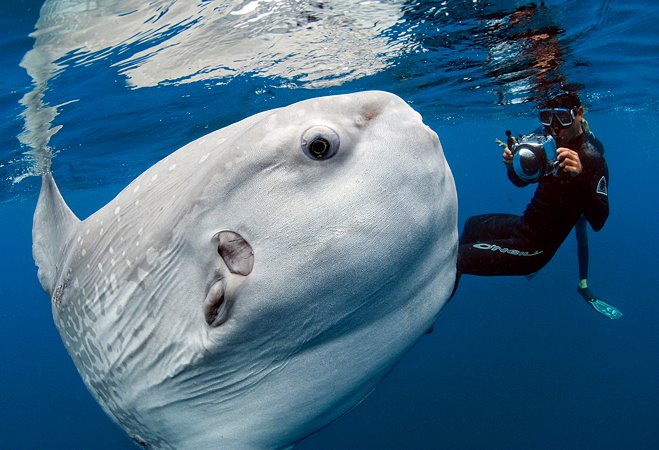
            Not only is the sunfish (Mola mola) the world’s heaviest bony fish, with some individuals weighing in at a staggering 2.3 tonnes, but it also possesses a truly bizarre body shape, likened to a gigantic ‘swimming head’. The sunfish has no tail, with the caudal fin reduced to a rudder-like structure, called the clavus. The dorsal and anal fins are placed far back on the body, and are used as ‘oars’ in swimming. The sunfish does not have scales, and instead has a tough, elastic skin which is covered in mucus. Also unlike other fish, it has fewer vertebrae, lacks bony tissue in the skeleton, and does not possess ribs, pelvic fins or a swim bladder. The mouth of the sunfish is small, and its teeth are fused together to form a ‘beak’. The sunfish tends to be brownish-blue to silver in colour, often with a slightly iridescent sheen, and it may also exhibit various patterns on the skin.


Scientific Classification
Kingdom
Animalia
Phylum
Chordata
Class
Actinopterygii
Order
Tetraodontiformes
Family
Molidae
Genus
Mola
Species
Mola mola

Other Names
English
Sun Fish
French
Poisson Lune
German
Schwimmender Kopf
Spanish
Pez Luna
Danish
Maanvis

Status
           The sunfish has yet to be classified by the IUCN.

Population
           Mola mola can produce more than 300 million eggs, each about 2 to 3mm large. More than any other known vertebrate. They are thought to live for over 10 years. However just like many marine creatures they are probably in danger of dwindling population from the increase pressure of fishing by human and other environmental factors. Scientists have not yet understood the biology of Mola mola and their distribution, hence they do not know yet for certain whether the population is dwindling, however a recent tagging by satellite to monitor the population of Mola mola in Californian waters show that there are consistent early indications that the population size has recently been reduced – possibly due to fishing pressure.

Habitat
           Ocean sunfish are native to the temperate and tropical waters of every ocean in the world. Sunfish are pelagic and swim at depths of up to 600 m. Contrary to the general perception that sunfish spend much of their time basking at the surface, research suggests that adult M. mola actually spend a large portion of their lives submerged at depths greater than 200 m, occupying both the epipelagic and mesopelagic zones.


Range
            Mola genotypes appear to vary widely between the Atlantic and Pacific, but genetic differences between individuals in the northern and southern hemispheres are minimal. Although early research suggested that sunfish moved around mainly by drifting with ocean currents, individuals have been recorded swimming 26 km in a day, at a top speed of 3.2 km/h. Sunfish are most often found in water warmer than 10 °C, prolonged periods spent in water at temperatures of 12 °C or lower can lead to disorientation and eventual death. Researchers theorize that surface basking behaviour, in which a sunfish swims on its side, presenting its largest profile to the sun, may be a method of "thermally recharging" following dives into deeper, colder water.  


Biology
           Sunfish are usually found alone, but occasionally in pairs or in large groups while being cleaned. They swim primarily in open waters, but are sometimes seen near kelp beds taking advantage of resident populations of smaller fish which remove ectoparasites from their skin. Because sunfish must consume a large volume of prey, their presence in a given area may be used as an indicator of nutrient-rich waters where endangered species may be found.

         The reproductive biology and behaviour of the sunfish are poorly understood. However, female sunfish are known to carry an extraordinary number of eggs, with an individual female capable of producing up to 300 million eggs at one time, the largest number of eggs ever recorded in a vertebrate. Where and when the sunfish spawns is not well known, although five possible areas have been identified in the North and South Atlantic, the North and South Pacific, and in the Indian Ocean, where there are central rotating oceanic currents, called gyres. The newly hatched sunfish measure just 0.25 centimetres in length, and will increase in mass by over 60 million times in order to reach the size of a 3 metre adult.


            The sunfish is thought to feed mainly on jellyfish, and its diet may also include a variety of alternative prey species including crustaceans, molluscs, squid, small fish and deep water eel larvae. The frequently observed ‘basking’ behaviour, where the sunfish swims on its side at the ocean surface, is thought to be linked to the deep dives which it makes periodically throughout the day, and which are most likely made in search of prey. Basking may be a form of thermoregulation, allowing the sunfish to warm up after making forays into cooler waters; however, other explanations for this peculiar behaviour include illness, or possibly the solicitation of cleaner fish or birds, for the removal of parasites. Known to harbour many parasites, at least 40 different genera have been recorded using the sunfish as a host, and crustaceans have also been found attached to the skin and gills of many individuals.


Threats
           The most significant threat to the sunfish is from fisheries, with the species comprising a huge proportion of bycatch in most fisheries that operate in the Pacific and Atlantic Oceans and in the Mediterranean Sea. The sunfish is not a commercially important fish, but in some areas of the world, it can make up as much as 90 % of the total catch, and will often greatly outnumber the target species caught in many hauls. This is especially concerning if the sunfish exists in discrete populations, rather than one large global population, as small, localised populations are at much higher risk of depletion or extinction.


Conservation Measures
           There are currently no conservation measures in place to protect this species, and perhaps more worryingly, there is very little information on the basic biology of the sunfish, including its foraging and diving behaviour, population structure, and its distribution and seasonal movements throughout the world’s oceans. There is growing recognition among the scientific community that further research on the sunfish is essential, especially in relation to how fishing-induced mortality is affecting the global population.


References
http://en.wikipedia.org/wiki/Ocean_sunfish
http://everything2.com/title/Mola+Mola
http://www.starfish.ch/reef/mola-sunfish.html
http://www.angelfire.com/mo2/animals1/tetra/oceansunfish.html
http://bss.sfsu.edu/holzman/courses/fall00projects/mola.html